KnowSleep

Why last night went the way it did

Your watch already measured the night. KnowSleep does the other half — it reads that night back to you as a paragraph, and once there are enough nights, as a report.

Download on the App Store

An iPhone is enough; an Apple Watch adds detail · No account · Nothing leaves your device

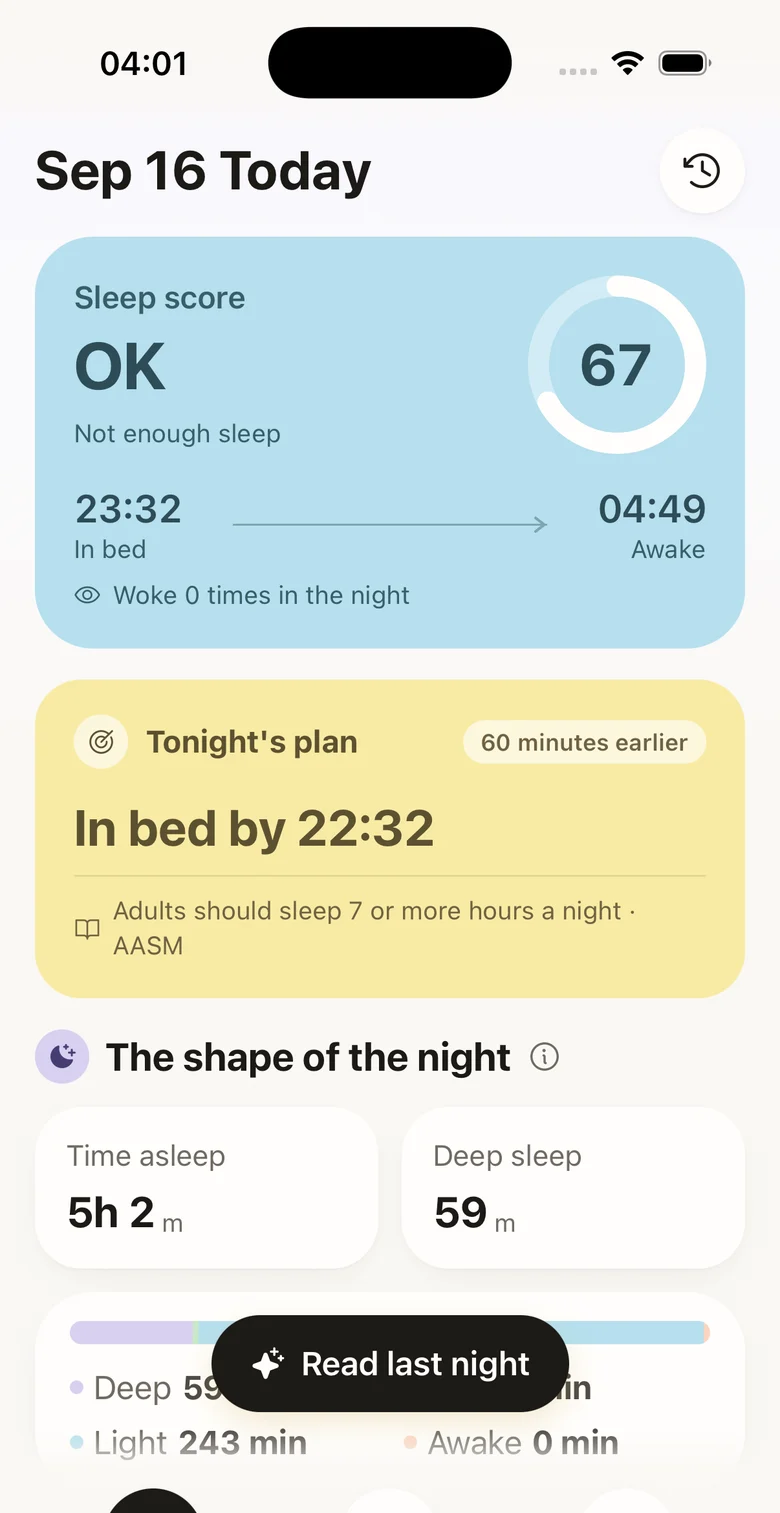
The KnowSleep home screen: a sleep score of 80, in bed 23:59 and awake 09:09, with tonight's plan and the shape of the night below

The problem

Every sleep app tells you how you slept
None of them tell you why

48 minutes of deep sleep, 58 bpm, HRV 42 — your watch has had those numbers all along. Reading them a hundred times still won't tell you what to change. What's missing is the sentence: "because you were still drinking coffee at three yesterday afternoon."

Working that sentence out needs one thing a watch cannot measure: what you actually did. That is the only thing KnowSleep asks you for — and you can skip it.

How it works

Three steps, under ten seconds a day

1

Tap once when you wake up

The home screen has one main action: read last night. There is no form you have to fill in daily — read whichever night you like, as many times as you like.

2

Add a note about yesterday (skippable)

Coffee, alcohol, a workout, stress, feeling unwell, a daytime nap, a change of routine, the phone in bed — tap whichever you remember. Caffeine and workouts can be read from Health, but they are shown beside the question as a reminder, never ticked for you.

3

Read four short sections

The headline, what the record shows, what it means given what you told it, and one thing to watch tonight. There is also a 「basis」 page: which records were used, what you added, how many nights of history it looked at — and what it deliberately did not use.

Nothing to read on day one? A switch in Settings fills the whole app with a 45-night sample so you can see what it does. Not one of your own records is touched.

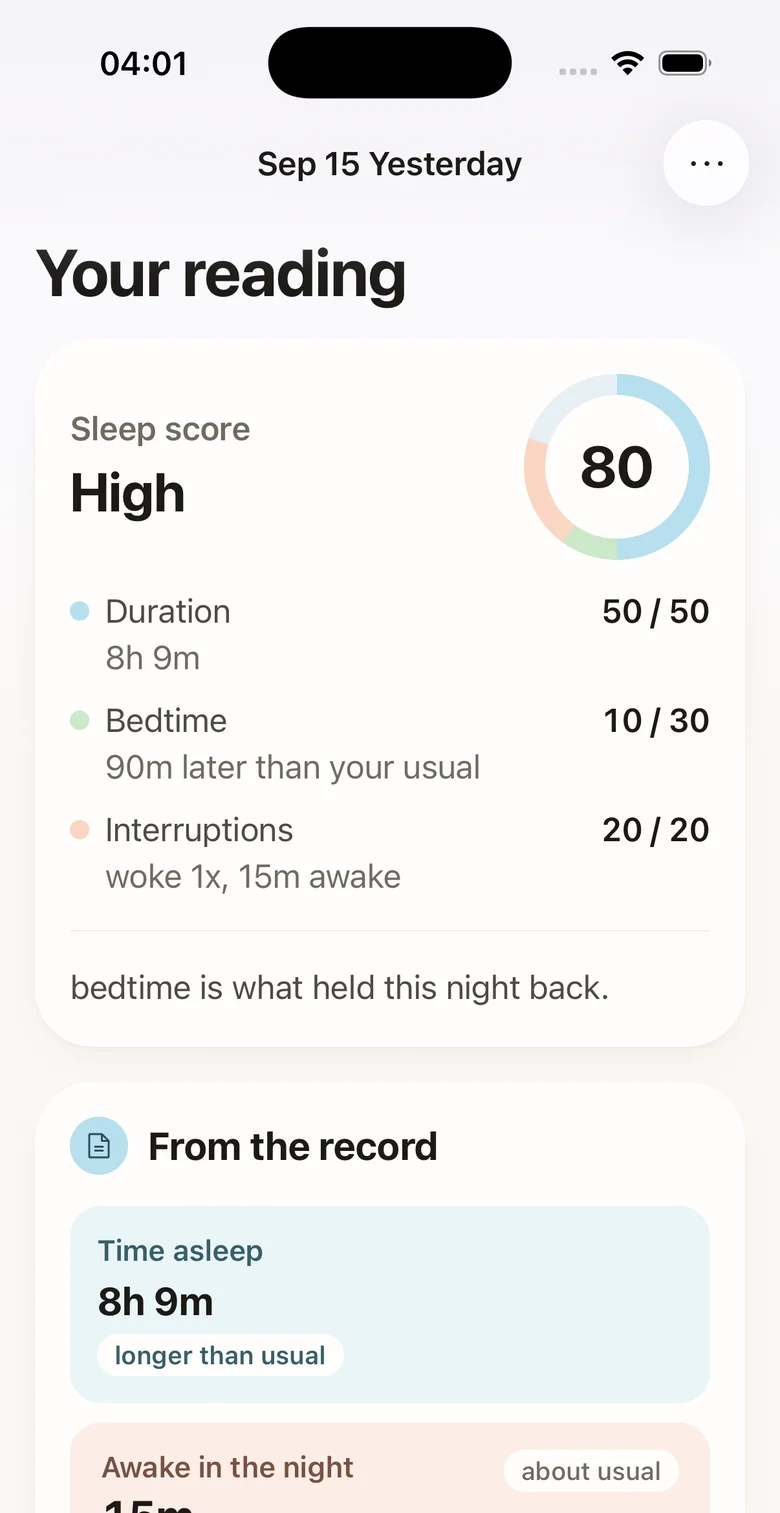
A sleep reading: the score of 80 broken into duration, bedtime and interruptions, with the figures from the record below

The point

This is what a finding looks like

Not "your sleep quality is below average" — anyone can say that. A sentence with your own numbers in it, and something you can go and change.

One lead from this month
Across the 9 nights you tagged "phone before bed", your median sleep score was 6 points lower than on the nights you didn't.
Compared only against you · never against a population

What matters more is when it declines to call one. A behaviour needs 4 nights with it and 4 nights without before it can be judged at all; anything that clears that bar then has to survive a correction for multiple comparisons (Šidák), so that one of eight behaviours isn't "significant" by luck. Short of that, it says so, and leaves it.

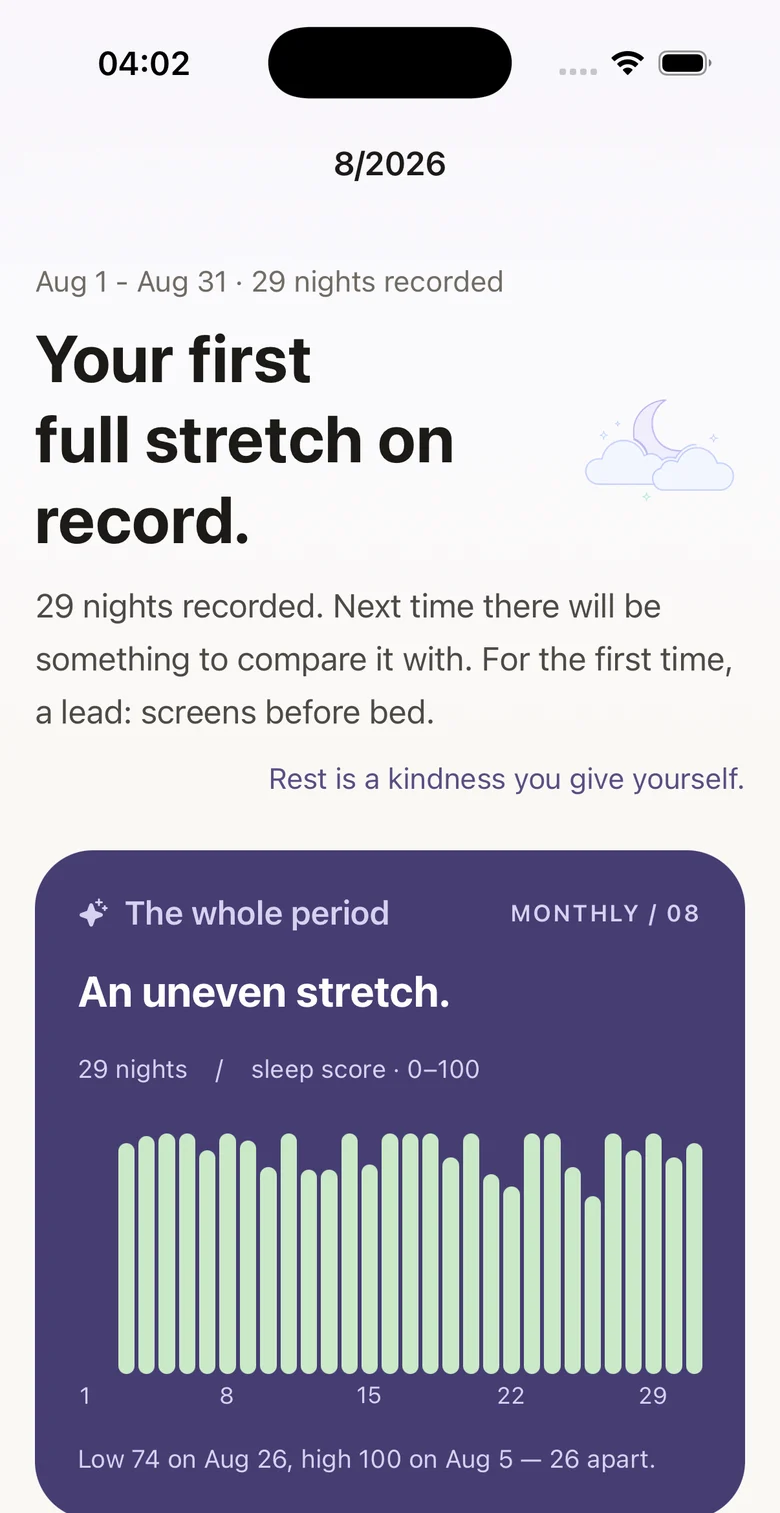
A KnowSleep monthly report: the cover reads "Your first full stretch on record.", above the whole period at a glance — 29 nights of sleep score as a rhythm chart

After enough nights

A monthly report written for one reader

Weekly, monthly, quarterly, yearly. Not numbers stacked on a page — something you can read to the end: the stretch at a glance, what changed in it, which habits genuinely line up with your sleep, and what the next one will pick up.

Phone before bed
6 points lower
Afternoon exercise
12 min more deep
Alcohol
Still watching · 2 to go
Late dinner
No effect found

"Still watching" is never quietly rendered as "no effect". It tells you how many nights are missing, and then stops talking.

Trends

Compared only against you

No population ranking, no "you beat 68% of users". A single night bouncing around is normal; what matters is where your own line is heading.

Sleep score, bedtime, deep sleep, sleeping heart rate and HRV — over a week, a month, a quarter or a year, or any stretch of dates you pick yourself. All free; no window is locked.

It works without an Apple Watch too: the iPhone's own in-bed records carry the score, bedtime and time asleep. KnowSleep will not average watch nights together with phone-only nights — a figure built that way isn't real.

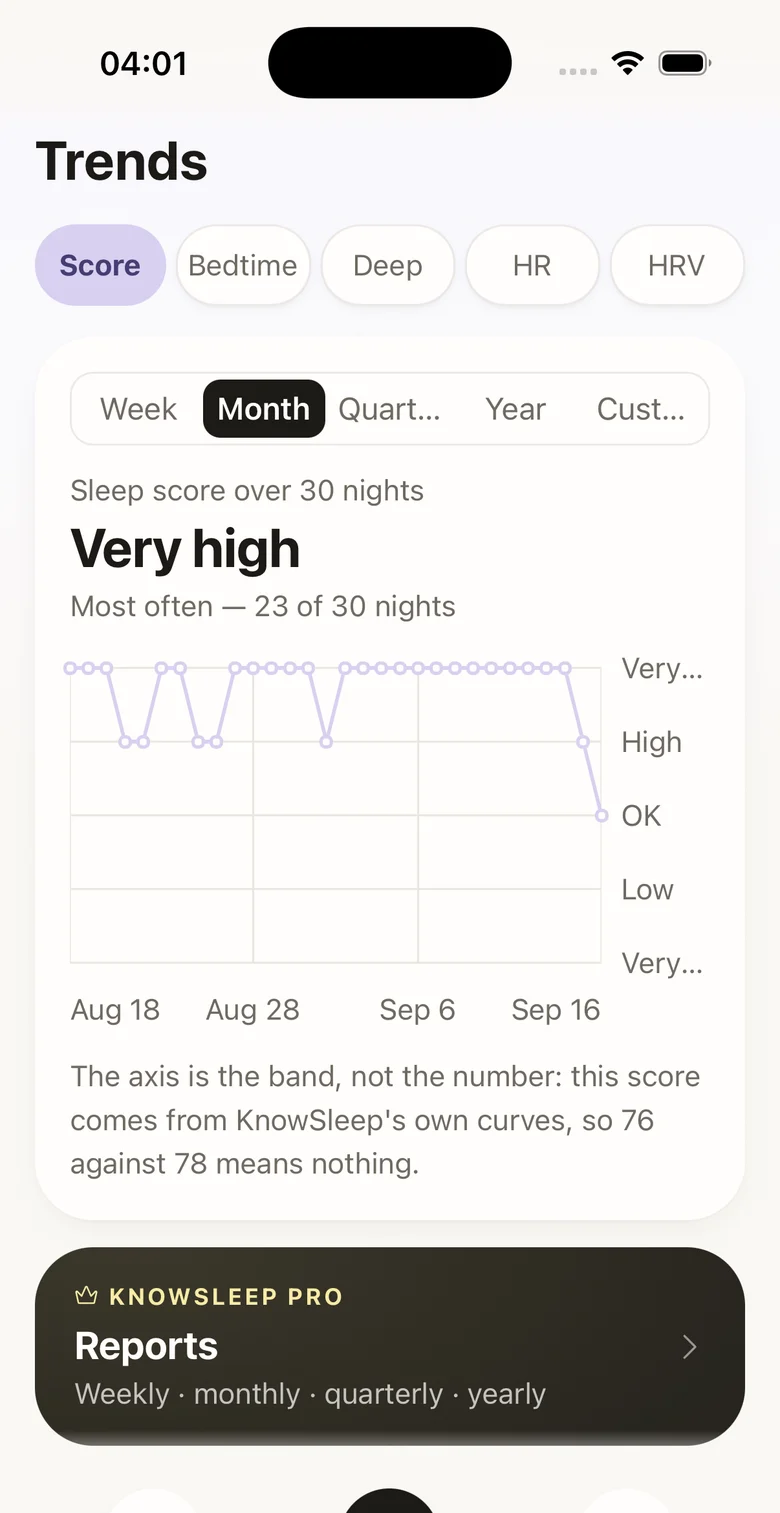
The trends screen: sleep score bands over the last 30 nights, most often landing in the highest band

Privacy

Nothing leaves your device — and that isn't a slogan

KnowSleep has no server. Not "we promise not to misuse your data" — there is nowhere for it to go.

No account

No sign-up, no email, no phone number. Install it and it works.

No backend

Every calculation happens on this iPhone. No sync, no cloud backup.

Reads a lot, writes almost nothing

Reads sleep, heart rate, HRV, blood oxygen, respiration, wrist temperature and a dozen other types from Apple Health. One thing goes back: the coffee you tag, and only if you switch that on yourself. Full list

No tracking

No ad SDKs, no analytics SDKs. Delete the app and the data goes with it — we hold no copy.

Price

Your own numbers are free. The report is what costs.

Exactly one thing is behind the purchase: the weekly, monthly, quarterly and yearly reports. Everything else is free, with no cap on dates or repeats — every night's full data and charts, the sleep score, a reading for any day, and trends over every window.

Free
$0
Every night's data and six charts, the sleep score, a daily reading for any date, all trend windows, share cards.
Yearly
$19.99 / yr
Includes a 7-day free trial. Unlocks the weekly, monthly, quarterly and yearly reports.
Lifetime
$29.99
One payment, no renewals. The app works out how many years of subscribing that is, at your own region's real prices.

The 7-day trial is provided by the App Store and starts when your subscription starts; cancelling within it costs nothing. Without subscribing you can read a complete sample report inside the app at any time — so you can see exactly what is on offer first. Prices shown are for the US App Store. Every other region has its own price, shown in your own currency before you pay.

KnowSleep does not diagnose. It is not a medical device and does not replace a doctor or a medical service. It reads your own history and offers lifestyle observations drawn from it. For anything to do with your health, talk to a doctor.